
YouTuber Builds 50V EV Battery Pack from 500 Recycled Vape Cells
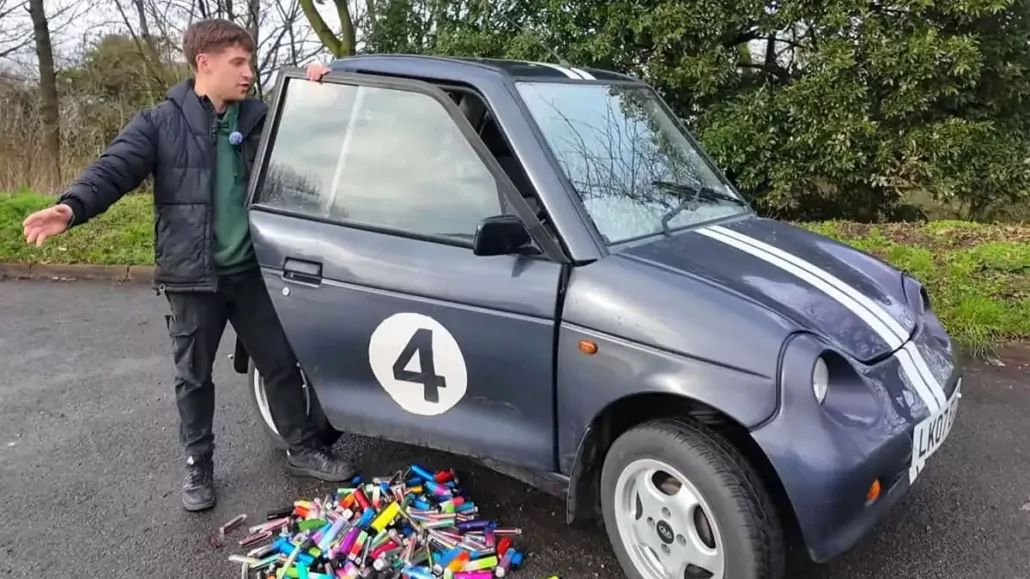
In a striking demonstration of circular economy potential, YouTuber Chris Doel has successfully powered a vintage electric vehicle using 500 recycled lithium-ion cells salvaged from disposable vapes. The project targets the notorious waste stream of single-use e-cigarettes, proving that discarded batteries often retain significant charge capacity. By reconfiguring these cells into a modular 2.5 kWh battery pack, Doel managed to drive a G-Wiz—an early 2000s micro-EV originally powered by heavy lead-acid batteries—at speeds approaching 40 mph.
Engineering the “Vape-Powered” Modular Pack
The technical execution involved rigorous safety protocols. Doel sourced hundreds of discarded vapes, extracting and testing each cell for health before integrating them into 3D-printed modular rows. These rows were connected in series to create a 50-volt system, closely matching the G-Wiz’s original 48V architecture. To mitigate thermal runaway risks—a common concern with lithium-ion projects—the custom pack features individual cell fusing, a robust Battery Management System (BMS), and a network of temperature sensors, all housed within a professional-grade aluminum enclosure.
A unique feature of this build is its charging interface: the entire vehicle can be replenished via USB-C, likely making it the world’s first USB-C powered EV. This highlights the versatility of modern consumer electronics standards when applied to automotive retrofits.
Performance Limitations vs. Environmental Impact
While the engineering is impressive, the “vape pack” has operational limits. The recycled cells can output a maximum continuous current of 120 amps, whereas the G-Wiz’s motor can demand up to 300 amps under heavy load. Consequently, flooring the accelerator trips the main breaker. In real-world testing, the vehicle achieved a top speed of roughly 40 mph (shy of the original 50 mph) and a range of 18 miles (compared to the original 50 miles).
Despite these performance deficits, the project serves as a powerful proof-of-concept for e-waste reduction. It demonstrates that the high-quality lithium cells currently being sent to landfills in disposable vapes have viable second-life applications, potentially in less demanding energy storage solutions if not in high-performance EVs.
| Metric | Original G-Wiz (Lead-Acid) | Recycled Vape Build (Li-Ion) |
|---|---|---|
| Battery Chemistry | Lead-Acid (Heavy/Toxic) | Lithium-Ion (Recycled Vapes) |
| Voltage | 48V | 50V (14 Series Rows) |
| Capacity | ~10 kWh (Est.) | 2.5 kWh |
| Top Speed | 50 mph | ~40 mph (Amp Limited) |
| Range | 50 miles | 18 miles |
| Charging | Standard Plug | USB-C |

- Which States Still Grow America’s Tobacco? The Post-Buyout Era - June 17, 2026
- Pennsylvania: Pittsburgh Passes Strict Vape Shop Zoning Bill - June 10, 2026
- Ohio: Yellow Springs Halts New Smoke Shops with 180-Day Freeze - June 10, 2026
Related posts:
 Indonesia Vape E-Cigarette Laws
 Watchdog Bans Elf Bar and HQD Vape Ads on Tiktok
 UK Government Exploring New Vape Taxes To Curb Youth Usage
 Alabama Vape Law Temporarily Blocked by Judge Gaines
 Alaska Settles with Juul & Altria for $7.8M Over Youth Marketing
 EU Proposes Outdoor Vaping Ban, Advocates Warn of Risks

