
Is the UK’s Generational Smoking Ban Pointless? A Data Dive

The United Kingdom’s Tobacco and Vapes Bill, currently making its way through the House of Lords, contains a headline-grabbing and almost unprecedented proposal: a generational smoking ban. This measure would make it illegal for anyone born on or after January 1, 2009, to ever legally purchase tobacco products. Proponents, including public health lobbyists and politicians, argue that without such drastic action, smoking will continue to be a prevalent habit among young people (typically aged 16-24), the very age group where most lifelong smokers initiate their addiction. However, a closer examination of recent data raises a critical question: is this ban a necessary public health intervention, or is it a solution in search of a problem that is already solving itself?
Youth Smoking Rates: A Dramatic and Ongoing Decline
The fundamental argument behind the generational ban is the need to prevent young people from starting to smoke. But what if the data shows this is already happening at a rapid pace? According to figures from the UK’s Office for National Statistics (ONS), the rate of new smokers among young people is not just declining; it’s plummeting.
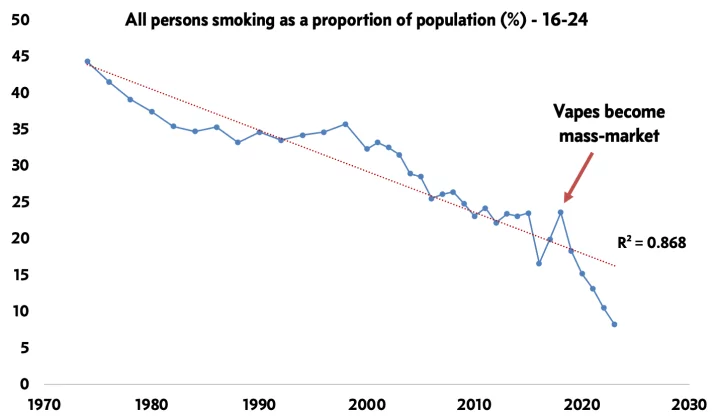
While there was a notable spike in smoking among young people in 2020 during the initial COVID-19 lockdown, reaching 23.6%, this appears to have been an anomaly. By 2023, the smoking rate in this demographic had fallen dramatically to just 8.2%. This steep downward trajectory is on track to achieve a “smoke-free” rate (typically defined as below 5%) within the next few years, potentially around the same time the generational ban legislation is set to come into full force in 2027. Linear trend modeling based on this data suggests that the current 18-24 age cohort is already heading towards becoming smoke-free organically. This raises the question: what is the point of a sweeping, liberty-restricting ban if the target behavior is already disappearing?
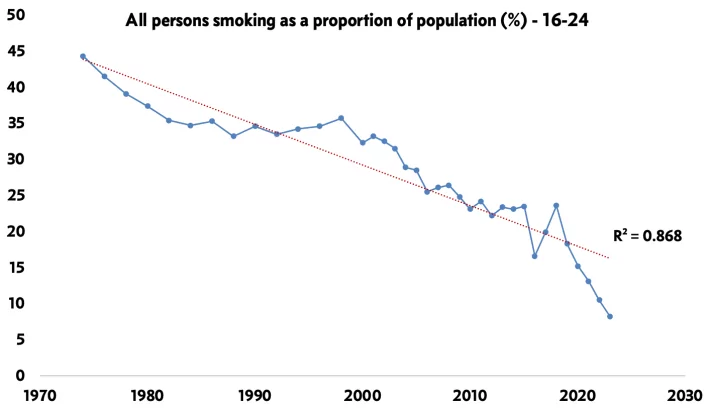
Some have credited the 2007 indoor smoking ban as the key catalyst for declining smoking rates. However, analysis from organizations like the Institute for Government, while supportive of the new bill, shows that the indoor ban barely made a dent in the pre-existing downward trend of smoking prevalence. The decline was happening before, and it continued at a similar pace after. Therefore, attributing the current drop solely to that single policy seems misguided.
The Real Driver: The Price of Nicotine, Not Just Tobacco
If not the indoor ban, what is driving this decline? A more compelling explanation lies in economics, but not just the price of tobacco. While it’s true that the cost of cigarettes has risen significantly since the 1970s, making up a greater share of household spending, the more significant factor has been the changing price and availability of *nicotine* itself.
The arrival and proliferation of less harmful nicotine alternatives – vapes, nicotine pouches, heated tobacco products, and gums – have fundamentally disrupted the market. These products have significantly displaced the role of combustible tobacco in nicotine delivery, thereby accelerating the decline in smoking. The timeline aligns perfectly: as innovative products like Juul gained traction around 2018, followed by the widespread availability of cheap disposable vapes by 2019/2020, the decline in youth smoking accelerated.
Vaping vs. Smoking: Choosing the Lesser of Two Harms
The increase in vape usage among young people is, of course, a regrettable public health concern, and no one endorses the illegal consumption of these age-restricted products. However, when faced with a choice between two options, it’s crucial to acknowledge the vast difference in their risk profiles. Combustible cigarettes are highly carcinogenic products that kill two-thirds of their long-term users. In contrast, vaping products are widely acknowledged by UK health authorities like Public Health England to be at least 95% safer than smoking. Given this, if a young person is going to use a nicotine product, it is far preferable for them to use a vape than a cigarette.
The reasons for vaping’s popularity over cigarettes are clear: they are generally cheaper (consumers are primarily paying for the nicotine, not the heavily taxed tobacco), they don’t leave users smelling of smoke, they require no auxiliary equipment like lighters, and, crucially, they often taste much better. This is why the number of vapers in the UK now rivals the number of smokers, and the trend is not in tobacco’s favor.

Ecigator Sticky Open Pod Kit (Box)
The Sticky Open Pod Kit is a contemporary vaping device that combines functionality with fashion. This kit is designed with a box-style form factor, offering a compact and stylish appearance that’s ideal for vaping enthusiasts on the move.
At the heart of this kit is a Refillable Open Pod System, with a capacity of 2ml, perfect for accommodating a variety of e-liquids. The pod is equipped with a high-quality Mesh Coil that not only ensures a rich and flavorful vaping experience but also boasts durability for up to 8 Refills.
The Pointlessness of the Ban and Its Unintended Consequences
This brings us back to the generational smoking ban. With the rate of new smokers already hurtling towards near-zero levels, and with tobacco harm reduction products actively shifting existing smokers away from cigarettes, what is the practical purpose of such a ban? Research from University College London (UCL) has shown that the likelihood of starting to smoke decreases significantly as young people age, further suggesting that the ban’s long-term impact on preventing new smokers will be minimal, as the trend is already moving in that direction.
Furthermore, the enforcement of such a ban presents a significant and unnecessary expenditure of limited resources. The government’s plan to increase Trading Standards’ budgets by £100 million over five years is unlikely to be sufficient to counteract the explosion in the black market for tobacco that is already taking place. A 44.4% drop in duty collected for cigarettes over four years strongly indicates a surge in criminal activity. The ban will likely exacerbate this, pushing the remaining demand for tobacco entirely into the hands of unregulated, criminal enterprises. Tellingly, Welsh Trading Standards initially came out in opposition to the ban, citing concerns about its long-term enforceability, though they later retracted this statement, possibly under political pressure.
While much has been written about the philosophical and ethical arguments against the generational smoking ban – its impact on personal liberty and individual choice – the data itself makes a powerful case. This appears to be a pointless ban, addressing a problem that is already resolving itself through market forces and the availability of safer alternatives. It threatens to cost the state significant resources in a futile enforcement effort, all while infringing on the liberties of future adults and potentially strengthening the very black market it claims to oppose.

- Indonesia: Denpasar Updates Smoke-Free Bylaw to Tighten Vape Rules - October 20, 2026
- Teen Girls Surpass Boys in Vaping Rates, Reversing Historic Trends - October 20, 2026
- Alabama: Irondale Proposes Public Vaping Ban with Fines Reaching $200 - October 20, 2026
Related posts:
 Massachusetts Cities Consider Generational Tobacco Bans
 New Zealand’s New Government to Repeal Generational Tobacco Ban
 Indiana Senator Introduces Generational Tobacco Ban Bill
 Black Market Boom: Is Australian Tobacco & Vape Policy Backfiring?
 Study Finds Vapes & NRT Help Rehab Patients Quit Smoking
 European Parliament Proposes Ban on E-Cigarettes in Public Spaces

