
NZ Smoking Rates Plateau, Vaping Rises: Smokefree 2025 Update
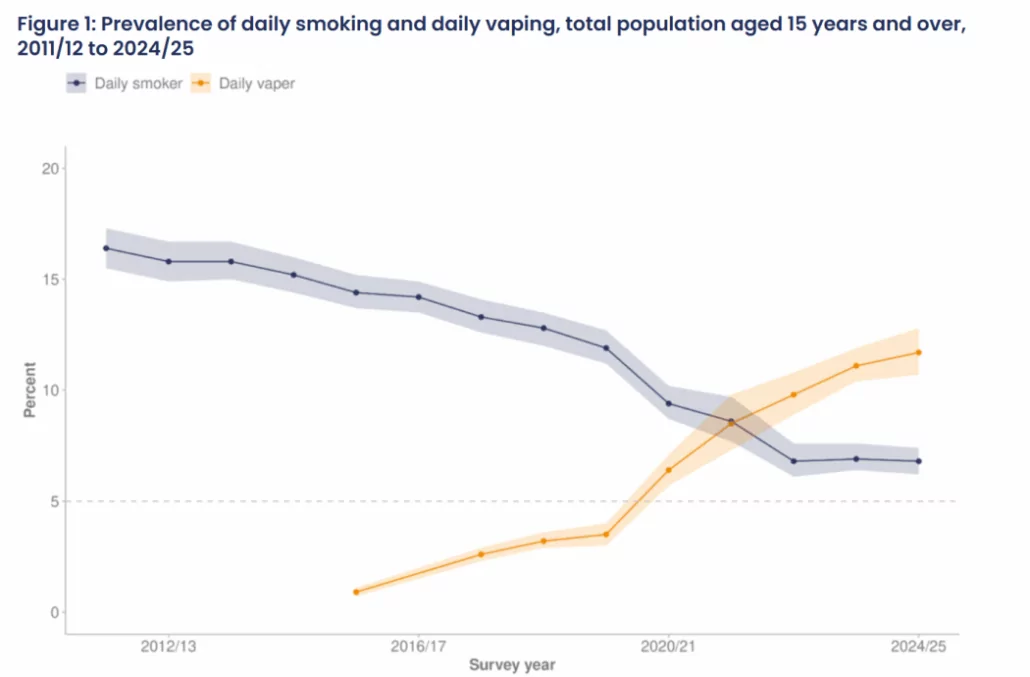
New Zealand’s progress towards its ambitious Smokefree 2025 goal has shown signs of plateauing, according to the latest New Zealand Health Survey. Data for the year ending July 2025 reveals that the prevalence of daily smoking dropped only fractionally from 6.9% to 6.8%. Concurrently, daily vaping rates have seen a slight increase, rising from 11.1% last year to 11.7% this year.
The survey estimates there are now 509,000 daily vapers in the country, a massive jump from just 33,000 in 2015/16. Vaping remains most prevalent among young adults, with more than one in four people aged 18 to 24 vaping daily. In contrast, the number of daily smokers has nearly halved since 2011/12, decreasing from 572,000 to 294,000.
These figures have sparked debate over whether the Smokefree 2025 target—defined as a smoking prevalence of under 5%—is still attainable. Advocacy group Vape Free Kids argues the data signals failure, noting the country fell far short of the estimated 82,000 quits needed in the last year. However, Associate Health Minister Casey Costello and the Action on Smoking and Health (ASH) group remain optimistic.
Minister Costello pointed out that the current data only covers up to June 2025, meaning the full year’s picture is yet to emerge. Ruth Bonita, Emeritus Professor of Public Health and ASH spokesperson, believes reaching the under 5% goal by next year is still possible. Both emphasized a major success story: the under-25 demographic is already effectively a “smoke-free generation,” with smoking rates hovering around 3%.
Bonita described the slowing decline in overall smoking rates as a “predictable pattern,” noting that as prevalence drops, further reductions become harder to achieve. Minister Costello highlighted that the data clearly identifies the 45 to 64 age group as the key demographic of long-term, addicted smokers that requires more targeted intervention. “The progress New Zealand has made means that those who currently smoke cigarettes are mostly older, long-term smokers,” she said.
The government aims to continue targeting these key populations, particularly older smokers and Māori and Pacific peoples, whose smoking rates have fallen significantly but need to decrease further. Costello affirmed the government’s commitment to practical steps, ensuring resources are used effectively to help people engage with quit-smoking providers and considering further regulatory changes to reflect product harms.

- Indonesia: Denpasar Updates Smoke-Free Bylaw to Tighten Vape Rules - October 20, 2026
- Teen Girls Surpass Boys in Vaping Rates, Reversing Historic Trends - October 20, 2026
- Alabama: Irondale Proposes Public Vaping Ban with Fines Reaching $200 - October 20, 2026
Related posts:
 Which Countries Are Leading the Global Decline in Smoking?
 California Enacts Stricter Laws on Flavored Vapes and Online Sales
 Florida’s Palm Coast Bans Smoking and Vaping in Public Parks and Trails
 Vape Flavor Bans May Increase Smoking in Young Adults: Study
 Is It Illegal to Vape or Smoke While Driving in Georgia?

