
Menthol Vaping Boosts Smoking Cessation Rates, Challenges EU Ban
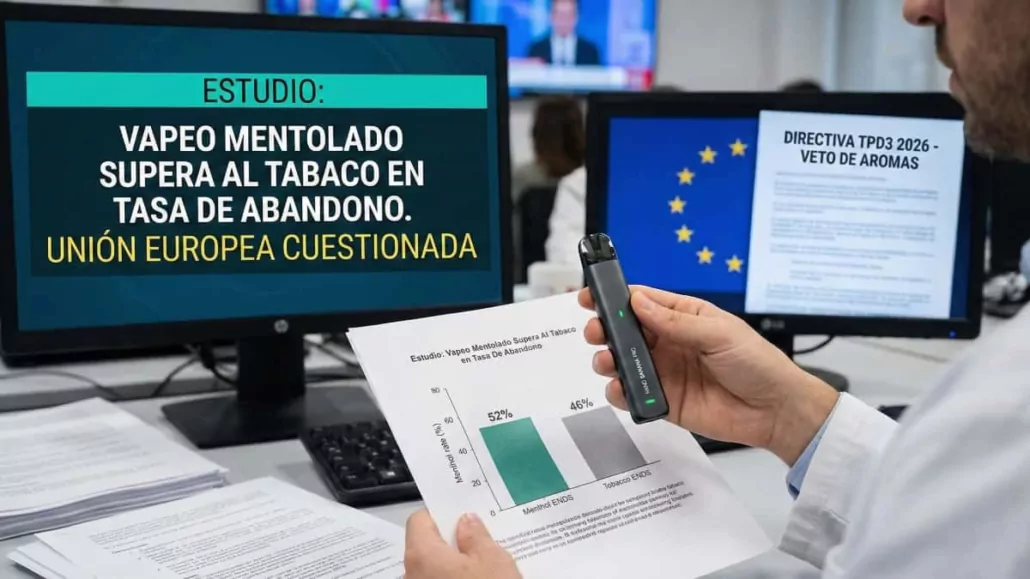
A massive longitudinal study involving nearly 23,000 adults has delivered a scientific rebuke to the European Union’s upcoming anti-vaping roadmap. Published in Internal and Emergency Medicine, the research reveals that menthol-flavored e-cigarettes are significantly more effective at helping smokers quit than tobacco-flavored alternatives. This finding directly contradicts the European Commission’s plan to ban all signature flavors, including menthol, in new nicotine devices by 2026.
Key Takeaways
- Higher Cessation Rate: Menthol vape users achieved a 52% quit rate for traditional cigarettes, compared to 46% for tobacco-flavored vapes.
- The Non-Menthol Paradox: The benefit was strongest among smokers of non-menthol cigarettes, for whom menthol vaping acted as a powerful catalyst.
- Policy Clash: The data challenges the EU’s 2026 TPD3 directive, which aims to extend flavor bans to all electronic devices.
- Robust Sample: The study analyzed 22,905 US adults over two years, using four statistical methods to ensure accuracy.
Core Finding: Flavor as a Catalyst for Quitting
The debate over flavor bans often centers on youth prevention, but this research highlights the cost to adult smokers. The data indicates that eliminating menthol alternatives could paradoxically slow the rate at which current smokers quit. Users of menthol-flavored Electronic Nicotine Delivery Systems (ENDS) showed a significantly higher probability of abandoning combustible tobacco entirely.
Data Snapshot: Cessation Probability
- Menthol Vaping: 52% Success Rate
- Tobacco Vaping: 46% Success Rate
- Impact: Menthol provides a ~10% higher relative effectiveness for non-menthol smokers.
The Paradox of the Non-Menthol User
One of the study’s most counterintuitive findings is the beneficiary profile. The additional cessation benefit of menthol was concentrated among adults who smoked traditional non-menthol cigarettes. For this group, switching to a menthol vape proved to be a more effective exit strategy than switching to a tobacco-flavored vape. This challenges the assumption that menthol vapes only serve existing menthol smokers. Instead, the distinct aroma appears to act as a psychological differentiator, helping users break the sensory link to burning tobacco.
Brussels vs. Science: The Legislative Collision
These findings place scientific evidence on a collision course with Brussels’ policy trajectory. The European Union has maintained a hard line since the 2014 Tobacco Products Directive (TPD), which banned flavored combustible cigarettes. The European Commission is now preparing the TPD3 directive for early 2026, aiming to extend this “zero tolerance” policy to e-cigarettes and nicotine pouches.
The Commission argues that flavors make products “more appealing” to youth, a stance upheld by the EU Court of Justice in 2016. However, the new data suggests that this appeal is exactly what makes the products effective for adult cessation. By banning the very feature that drives success—the flavor—regulators may inadvertently protect the cigarette market.
Does the EU ban menthol vapes?
Not yet, but it is planned. The European Commission’s TPD3 directive, expected in early 2026, proposes extending the existing ban on flavored cigarettes to include e-cigarettes and nicotine pouches, specifically targeting menthol.

- Indonesia: Denpasar Updates Smoke-Free Bylaw to Tighten Vape Rules - October 20, 2026
- Teen Girls Surpass Boys in Vaping Rates, Reversing Historic Trends - October 20, 2026
- Alabama: Irondale Proposes Public Vaping Ban with Fines Reaching $200 - October 20, 2026
Related posts:
 Western Australia Bans Vaping in All Enclosed Workplaces
 New York Proposes Ban on Flavored Nicotine Pouches Like Zyn
 Vaping Industry Adapts to Regulatory Changes and Tax
 NHS England Offers Varenicline Pill to Help Smokers Quit
 University of Michigan Study Explores Reasons Behind Teen Vaping
 Hong Kong Proposes Public Vape Ban & Flavor Restrictions

