
Perceiving Vaping as Safer Helps Young Adults Quit Smoking: Study

Young adult smokers aged 18 to 24 who correctly perceive vaping as less harmful than smoking traditional tobacco are more likely to successfully quit cigarettes, according to a new British study published in the Oxford Academic journal, Nicotine & Tobacco Research. The six-year cohort study, which followed over 3,000 young adults in England, provides significant evidence that understanding the relative risks of nicotine products can directly influence healthier behaviors.
The research, titled ‘Perceived harm of vaping relative to smoking and associations with subsequent smoking and vaping behaviors among young adults,’ is the first of its kind to longitudinally analyze how harm perceptions are associated with tobacco and vaping behaviors in this specific age group. The findings revealed that the perception of vaping being less harmful was strongly associated with a transition away from combustible tobacco.
Among participants who smoked but did not vape at the beginning of the study, their trajectory over six years was telling. By the end of the follow-up period, 32% were still smoking, but a larger group, 37%, had quit smoking and switched to e-cigarettes. Another 14% had quit both habits entirely. The statistical analysis confirmed that those who perceived vaping as less harmful had a higher likelihood of quitting tobacco in favor of a lower-risk product compared to those who believed both were equally or more harmful, or were unsure.
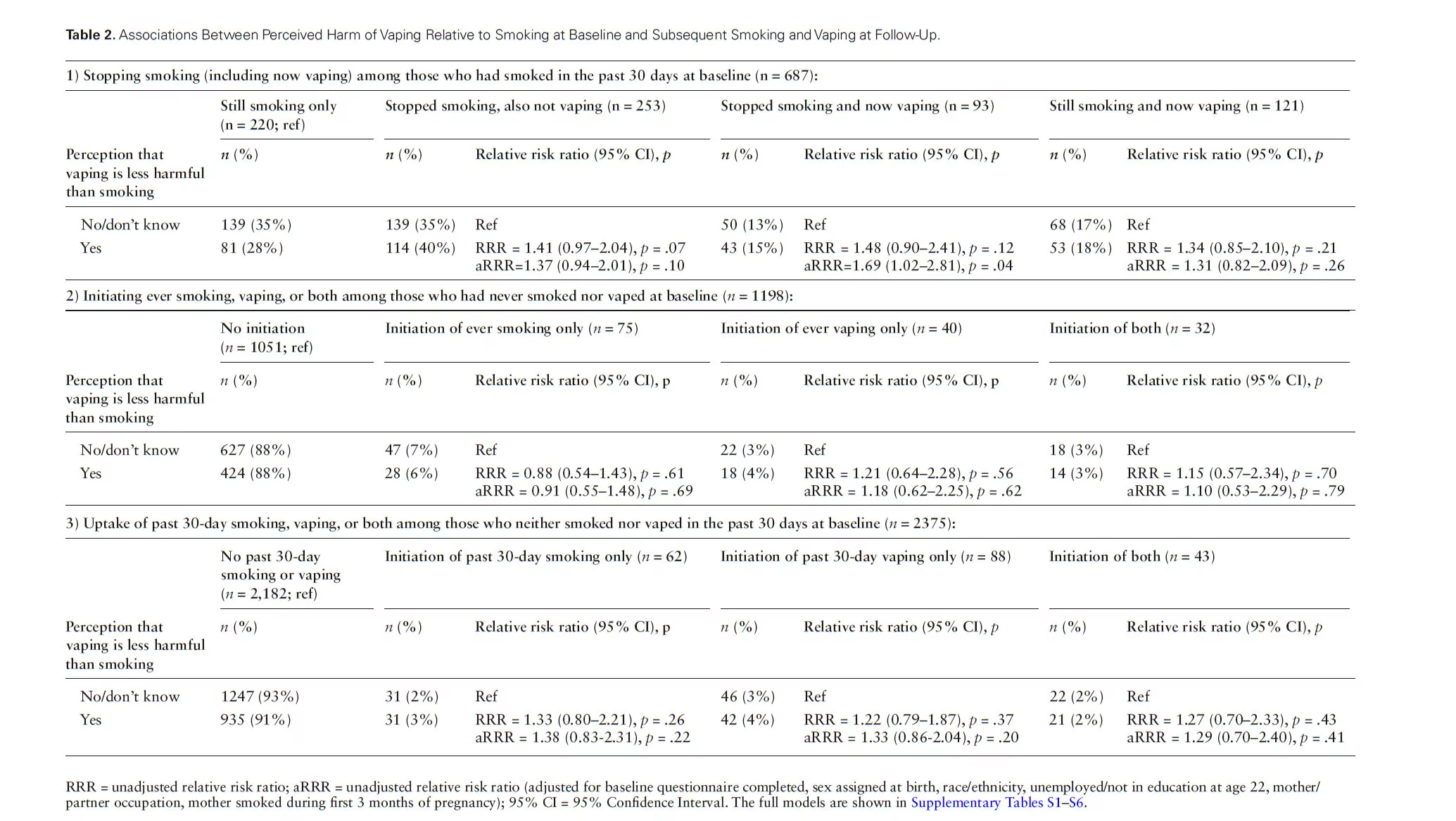
However, the study also documents a worrying trend of public misperception. Despite scientific evidence from bodies like Public Health England indicating vaping is substantially less harmful than smoking, an increasing number of smokers perceive it as equally or even more dangerous. The authors cite national surveys showing that the proportion of British smokers who wrongly believed vaping was as or more harmful than smoking rose from 59% a decade ago to 85% more recently.
The study also followed a group of over 1,100 participants who had never smoked or vaped. Over the six-year period, the initiation of either habit was very low: 6% tried cigarettes, 3% tried vaping, and 3% tried both, with no clear link between these behaviors and their risk perceptions.
The authors conclude with a simple but powerful message: if society and public policies fail to clearly distinguish between the significant risks of combustible tobacco and the much lower risks of vaping, a crucial opportunity to help thousands of young adults quit smoking could be lost. Correctly communicating the relative risks of vaping versus smoking can open real opportunities for young adult smokers to adopt healthier behaviors.

- Indonesia: Denpasar Updates Smoke-Free Bylaw to Tighten Vape Rules - October 20, 2026
- Teen Girls Surpass Boys in Vaping Rates, Reversing Historic Trends - October 20, 2026
- Alabama: Irondale Proposes Public Vaping Ban with Fines Reaching $200 - October 20, 2026
Related posts:
 Hong Kong Plans Ban on Flavored Tobacco Except Menthol Starting 2026
 Understanding China’s Vape Regulations: Everything You Need to Know
 French Vaping Advocacy Group SOVAPE Announces Dissolution Amid Challenges
 Finland Regulates Nicotine Pouches, Bans Flavors, Online Sales
 Poland Announces Disposable Vape Ban
 Critics Warn Illinois Indoor Vaping Ban Could Backfire

