France’s Proposed Vape Tax & Online Sales Ban Sparks Outcry

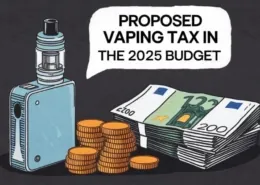
The French government is facing significant backlash from vapers, medical professionals, and business owners over proposed new regulations that would align e-cigarettes more closely with traditional tobacco. Article 23 of the draft finance bill for 2026 includes a new excise tax on e-liquids, a total ban on online vape sales, and stricter administrative oversight for vape shops, placing them under the authority of customs, similar to tobacconists.
The proposed tax, set to begin in spring 2026, would add an excise duty of €0.03 per milliliter for e-liquids with up to 15 mg/ml of nicotine, and €0.05 per milliliter for those above that concentration. This would increase the price of a standard 10ml bottle by 30 to 50 cents, with the stated goal of raising €150-€200 million annually for the state. More impactful, however, is the proposed total ban on the sale of all vaping products via the internet, a channel that currently accounts for an estimated one-quarter to one-third of all vape sales in France.
The independent French vape industry, which has largely developed separately from major tobacco companies, warns these measures could be devastating. The Interprofessional Federation of Vaping (Fivape) estimates the online sales ban alone could eliminate 3,000 jobs, with up to 20,000 direct and indirect jobs threatened overall. Fivape president Jean Moiroud launched a petition against Article 23, which quickly garnered over 200,000 signatures, signaling strong public opposition to equating vaping with smoking.
This legislative push comes as the medical consensus in France is increasingly leaning in favor of using e-cigarettes as a regulated tool for smoking cessation. In October, the French-speaking Society of Tobaccology published a consensus concluding that the benefit-risk balance of vaping is positive for smokers. Recent studies support this, with a 2025 study in Annals of Internal Medicine showing 29% of vape users quit smoking in six months, compared to under 10% using traditional substitutes. Pulmonologist Bertrand Dautzenberg summarized the view: “For a smoker, the e-cigarette is useful. For a non-smoker, it is useless,” positioning it as a harm reduction tool, not a gateway to tobacco.
The proposed tax has faced political hurdles. In late October, the finance committee adopted an amendment to remove the e-liquid tax for 2026, arguing that an EU directive only mandates a minimum tax from 2028. However, the ban on online sales was maintained. The future of the bill remains uncertain as it navigates the legislative process. This move contrasts with the UK’s approach, which has actively promoted vaping for smoking cessation, even distributing free e-cigarettes to smokers. French data from the ESPAD 2024 survey also challenges the “gateway effect” argument, showing a dramatic drop in daily smoking among 16-year-olds from 12% to 3.1% between 2019 and 2024, while vaping rates remained stable at around 5.8%.

- Indonesia: Denpasar Updates Smoke-Free Bylaw to Tighten Vape Rules - October 20, 2026
- Teen Girls Surpass Boys in Vaping Rates, Reversing Historic Trends - October 20, 2026
- Alabama: Irondale Proposes Public Vaping Ban with Fines Reaching $200 - October 20, 2026